If Momma Ain’t Happy, Ain’t Nobody Happy

One of the old jokes Nancy and I have woven into our relationship goes like this, as I tell it.Man-Laughing  “When we were first married, I decided that I would make all the big decisions and that Nancy could make all the small decisions.  Luckily for us, in over 38 years of marriage, there haven’t been any big decisions…”  At the heart of this laugher is the concept of influence, the extent to which spouses allow their mate to shape their thinking and actions.  And according to the Gottmans, couples who share influence with one another are more likely to have lasting, fruitful and rewarding marriages than those who don’t.


couple talkingIn the 21st century, it is amazing to me that we still see and hear vestiges of 19th century thinking on this subject, marriages in which the husband assumes the role of the dominant decision-maker, with the wife taking the inferior position of having to defer to his judgment (or lack thereof) and live with decisions he makes almost entirely on his own.  Less common, I suspect, are marriages in which the wife makes most of the decisions, and the husband meekly accepts orders and direction from her.  These types of relationships lack equilibrium and are, hence, less stable than relationships in which influence is mutually observed and decisions are shared.  Personally, I’m not sure I would be happy in either extreme, as I don’t like the feeling of being directed or pushed around, but also lack confidence in my ability to make important decisions on my own.  One of the qualities that attracted me to Nancy in the very beginning was her assertiveness, the clear understanding that I would not be piloting this relationship entirely by myself.

How does your own relationship stack up in this area?  The following 20 true/false questions were developed by The Gottman Institute in order to help couples assess the extent to which they allow their spouses to influence them.  Perhaps you and your spouse feel you liberally allow one another to influence the thinking and actions of the other.  If you’d like to test that theory, cut and paste the following questions into a Word document, print it twice, sit down together, answer the questions, and compare your answers.

1. I am really interested in my partner’s opinions on our basic issues. T    F 
2. I usually learn a lot from my partner even when we disagree. T    F 
3. I want my partner to feel that what he or she says really counts with me. T    F 
4. I generally want my partner to feel influential in this marriage. T    F
5. I can listen to my partner, but only up to a point. T    F
6. My partner has a lot of basic common sense. T    F
7. I try to communicate respect even during our disagreements. T    F
8. If I keep trying to convince my partner, I will eventually win out. T    F 
9. I don’t reject my partner’s opinions out of hand. T    F
10. My partner is not rational enough to take seriously when we discuss our issues. T    F
11. I believe in lots of give and take in our discussions. T    F
12. I am very persuasive and usually can win arguments with my partner. T    F
13. I feel I have an important say when we make decisions. T    F 
14. My partner usually has good ideas. T    F
15. My partner is basically a great help as a problem solver. T    F 
16. I try to listen respectfully, even when I disagree. T    F 
17. My ideas for solutions are usually much better than my partner’s. T    F
18 I can usually find something to agree with in my partner’s positions. T    F
19. My partner is usually too emotional. T    F
20. I am the one who needs to make the major decisions in this relationship. T    F

Cute-Romantic-Love-CoupleAn excellent metric for your ability to influence one another follows:  If answering these questions and discussing your responses leads to an argument, you may need to work on this aspect of your relationship.  If answering these questions and discussing your responses leads to sex, you’re probably doing okay.

Temperament and personality types will enter into this process.  For Nancy and me, in that we have significantly different preferences when it comes to Myers-Briggs typing, it is generally helpful when we sit down together to iron out disagreements.  As Gottman points out, the process of reaching external conflict resolution often relies on one’s ability to reach internal conflict resolution first, by learning to accept influence from one’s partner.  Early in relationships, this can be a challenge, as most of us enter marriage having relied almost exclusively on our own judgment for some period of time.  Overcoming disagreements requires us first to acknowledge that our partner’s point of view, though different from ours, may, in fact, be as valid, or even more valid, than our own.  Over time, and with practice, couples in successful relationships can learn how to navigate such differences with relative ease.

I suspect this is not always true with couples whose Myers-Briggs profiles are more similar.  In such marriages, it seems to me that significant disagreements may be more rare, but may be harder to resolve since each spouse approaches decision-making in a similar way.  In these instances, it may be that the best outcome the couple can hope for is to agree to disagree, a sub-optimal solution which, over time, may evolve into a “we just don’t seem to agree about anything” position that could require professional counseling.

One of the most mis-applied verses in scripture is found in Ephesians 5:22-24, which is often used to suggest that women must be submissive to their husbands.  But by reading through verse 33, it becomes clear that God expects equality in our marriages.  Husbands, if you wish to justify 19th century thinking by applying only the first three verses from this passage, you are likely to end up with an unhappy wife.  And, as the old saying goes, if momma ain’t happy, ain’t nobody happy.

eph-5-25-web-w

There’s No Pill for Boring

If you were to organize a game of Family Feud with married couples under the age of 30–Family_feuddividing the teams into husbands versus wives–and the question was, “Which aspect of your relationship do you most fear losing in the next 30 years?”, topping the list for the men would probably be some version of “losing my world-class sexual virility.” Even those of us who consider ourselves to be merely average lovers might put this response in the top three, alongside “no longer being able to support my family” and perhaps “having to become the primary caregiver for our kids/her mom/anyone, really.”  Of course, I have no clear idea as to the answers that might top the ladies’ list, which would require more insight into the female psyche than I’ve ever possessed.

Anyway, the fear of no longer being able to satisfy our wives sexually is, I think, fairly universal among husbands.  Evidence for this comes in the sheer volume of ads featured on ESPN-type sports channels and NFL games for drugs that treated the dreaded “E.D.” and which, by most accounts, adequately address the problem for many, if not most guys. (These ads do not, of course, suggest that, at age 60, our wives may not want us to be Hugh Jackman in the marital bed, instead preferring more of a Michael Buble-type of experience.)  The point here is that, for us husbands and our primary concern growing older–THERE’S A PILL FOR THAT!

Busy-ParentsFor young married couples with children, what few private conversations we’re able to share probably center around the kids, our jobs and the news of the day delivered by our TV sets–sports, a murder somewhere, bad weather, etc.  In the evening, once the kids are safely in their beds, we sit down in front of the TV, suck up a little screen, and then head up to bed, preparing to do battle with the world again the next day.  Published data suggests that married couples with children spend, on average, something like seven minutes a day actually talking with one another.  I suspect that many of these conversational snippets include one or both spouses punching away on a smartphone.

My wife Nancy shared an observation with me years ago that stuck in my head.  She said that the only difference between a person today and that person a year from now is the places he (or she) has been, the people he’s met, and the books he’s read.  For many parents with busy kids, travel opportunities are often limited, our circles of friends include mostly other parents, and we rarely have time to luxuriate with a good book for a few hours.  Over time, these problems change, but don’t go away.  Our children and their schedules continue to dominate our non-work time, even after they leave for college or elsewhere, our circles of friends tend to shrink as people move or get divorced, and the amount of free time available to us never seems to grow.  If we’re fortunate enough to advance in our careers, work increasingly intrudes on both our family and free time.

As the expression goes, life is what happens while we’re busy making other plans.   Suddenly we’re in our fifties, empty-nesters, with fewer friends than we used to have.  Our careers may be winding down, or perhaps we’ve been displaced from once lofty jobs and have joined the legions of post-50 workers facing unemployment, or under-employment, in which the job satisfaction quotient is drastically reduced, along with the space in our consciousness formerly occupied by work.

As couples, the question, suddenly, is, “What are we going to talk about together?”  If you couple talkingtrack divorce statistics, you see the predictable spike around the so-called “seven year itch”, but then observe another one that jumps up around year 30.  It is this second one that we must prepare for, as it is avoidable and at least as destructive as the early one.  It is the one that would leave us facing the rest of our lives alone, damaged by the loss of three decades of our personal life story, contemplating the brutal prospect of re-entering the “dating game” and its attendant impossibilities.  As Catholics, it is also one bereft of the possibility of a second marriage, one which is even more likely to fail than was the first.

The challenge, and the opportunity, is to remain interesting to each other.  To take advantage of the occasional stolen minutes or hours while we’re young to go to a museum or gallery, meet some new people through, say, volunteer work or a parish ministry, and to read books.  Reading books is, by far, the easiest, as Kindles and books-on-CD offer opportunities to turn dead time spent waiting in airports, driving our cars, or waiting in our cars for soccer practice to end into time spent staying relevant and interesting.  What we see, where we go, and what we read is not nearly as important as the seeing, the going and the reading itself.

The momentary discussions about our kids, our jobs and the news du jour will, over time, give way to expanses of time together.  When that time comes, it is important that we have things to talk about.  As we mature, we owe it to our spouses, even if we can’t stay physically buff and movie star-gorgeous, to remain interesting, aware of the things each other takes pleasure in, and capable of conducting a coherent personal conversation. Otherwise, we are at risk for becoming incurably, terminally dull.  And there’s no pill for boring.

old-couple in love

Four Ways to Be a Better Spouse

Here we go again, with an article borrowed from Huffington Post.  This one has a semi-Buddhist flavor to it, which is a switch from our usual fare.  Unfortunately for you, this fact reminds me of the only Buddhist joke I know, in which the Buddhist says to the hot dog vendor on the streets of New York, “Make me one with everything.”  Wait for it…  Anyway, since the article refers to I Corinthians, I thought it would fit in our blog.

PsychiatristBrandy Engler is a clinical psychologist and the author of The Men on My Couch: Stories of Sex, Love and Psychotherapy.  Her recent post, “Four Ways to Love Better” visits a recurring theme on this blog, namely, rather than seeking the right partner, we should BE the right partner for our spouse.  As most people married more than once will attest, in the absence of abuse–physical, mental, drug–the grass is rarely greener on the other side. We bring most of our relationship problems with us; if we’re capable of cheating on one spouse, we’re obviously capable of cheating on another, etc.

Engler does not specifically address marital love in this post; rather, she points us toward a wider, more inclusive love of the world and the people in it.  This is a very Christian attitude from a writer who strikes me as not overly, or overtly, Christian.  But by inference, we are to include our spouses in this view.  And if you can guess her four prescriptions for being a more loving person, well, you’re better at this stuff than I am.  YOU should be posting on this blog.


Holy Matrimony, from Salvo Magazine

Unbeknownst to me until after I shared it, the link in the previous re-post “Be fruitful, multiply…and have a good time” came to us from Fr. Richard Doerr, the pastor at Our Lady of Mt. Carmel.  Father Richard must be catching up on his reading, as he has also provided this article from Salvo Magazine.

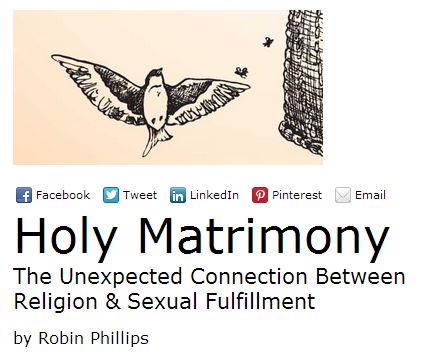
Holy Matrimony

Though the subject matter, and the conclusions, are similar, comparing Salvo Magazine to US News & World Report is like comparing Masterpiece Theater to Sesame Street.  This is a much more in-depth look at the relationship between one’s spiritual life and one’s sexual satisfaction.  Parts of it are, bluntly speaking, clinical.  It draws from a number of research studies and articles, ranging from The University of Chicago and C.S. Lewis to Redbook, and concludes that piety does not equal prudishness.  To the contrary, the subtitle–The Unexpected Connection Between Religion & Sexual Fulfillment–pretty much tells the story.

For me, the most encouraging part of these two posts, aside from the conclusions, is that we appear to be inching ever closer to the day when we will be able to share actual blog posts from Denise McGonigal and Fr. Richard, two of the most articulate voices in our parish community on the subject of sacramental marriage.  This blog went live back in January with the idea that both would be occasional contributors.  And while this hasn’t yet been the case, we seem to be making progress.  Christians across the globe have been awaiting Christ’s return for two millennia; followers of this blog can easily wait a few more weeks, or months, or years even, for the Holy Spirit to move our leaders to join this conversation.

Robin Phillips is the author of the book Saints and Scoundrels and is working on a Ph.D. in historical theology through King’s College, London.                                                         Robin blogs at http://robinphillips.blogspot.com.

Support Salvo Magazine here.

Do You Need God to Raise Your Kids?

Here’s another thoughtful post from our favorite guest blogger, Anne Slamkowski. Please visit her Making Room for God blog.

HYesterday, I blogged on a difficult subject: God and Marriage.  One of the issues that has comes up time and time again in conversations is how do you balance kids and marriage.  Not an easy topic to tackle for sure!  Kids complicate and at the same time lift up your marriage.  Kids give us joy and bring us turmoil.  Kids (and finances) are the first time you learn to sacrifice your selfish desires for your spouse.  No kidding. 

 When you first got married can you remember trying to figure out who was going to pay the bills and how you were going to share the money that was coming in?  Can you remember the first time you had to make a decision together about your kids’ future?  I would venture to guess that it wasn’t an easy decision.  There may even have been some arguing.   So when we talk about divorce rates in families today, we cannot help but discuss both financial issues and trouble with kids. 

One of the issues with kids is when things go badly.  Maybe (like me) you have a child that has medical issues or behavioral problems.  Maybe you have a child who suffers from mental illness.  Maybe you have a child who is constantly making bad choices.  Maybe you have a child that suffers from alcohol or drug addiction.  There are so many problems that parents are faced with today. Yet did any of you have training for this during your marriage prep classes?  Pete and I sure didn’t.   Nobody pulled us aside and said, “Heh, not all kids are perfect.”  No one told us the adventures we would be faced with when we started to grow our family.  No one told us that our kids could make bad choices no matter how good of parents we are.  The problem is we don’t have anything to model our lives after because all kids are different.  We cannot look at our own parents and make good parenting decisions because they lived in different circumstances.  All we have to rely on is each other and instinct.  When things go badly with our kids we tend to point fingers.  Have these words ever been spoken (or thought) about in your household:

“If you would have done or said this to him/her, we wouldn’t be in this place!” 

“If you would be home more often, then he/she would show more respect for us as parents.”

“If you would have disciplined better when he/she was young, then we wouldn’t be faced with these issues.”

“If you would do your job as a housewife, then our kids wouldn’t make these choices.”

“If only I would have treated my body better during pregnancy, then these medical issues wouldn’t have happened to my child.”

“Maybe I have done something to him/her to make him/her this way.”

“Maybe God is punishing me for something in my past.”

All of these comments go on in our brains.  They are doubts that arise during parenting.  I know because Pete and I have beaten ourselves up over why Katie has behavioral issues and seizures. We have blamed each other and ourselves.  Our doubts could have ruined our marriage, but we chose God over doubt.  Thank goodness! 

One of the best lessons that I have ever been taught is that my own kids are not my possessions. My kids belong to God.  They are children of God.  God has entrusted their care to me.  I love this because it reminds me that my kids are entrusted to me not because I deserved them, not because I purchased them, not because I own them, but because God gave me the opportunity to raise them for Him.  Whether you have adopted your children or given birth to your children, they are not your possessions.  Nope.  They are God’s children.  He gave you this opportunity.  What you do with this opportunity is now up to you.  You can choose to raise them without asking God for help, or you can raise them with God’s strength.  I choose the latter. 

If Pete and I were to dwell on all the mistakes we make as parents, I can tell you right now we would be miserable.  I make parental mistakes every day.  I try to learn from these mistakes.  I do my best to ask God daily for strength.  I constantly pray to God to show me what He needs me to do. 

Kids can be part of the problem in a marriage for sure, but they also can lift up your marriage.  If you realize now that kids are not your possessions.  Kids are not a way for you to re-live your childhood.  Kids are not an opportunity for you to show your own parents what they did wrong. Kids are a way for you to connect closer to God.  They are a way for you to see God’s beauty.  They are your pathway to a greater faith life.   f you are having issues with your own marriage that revolves around your children, ask God for help today.  Reconnect individually with your faith.  Find a way to keep God first in your life.  No one can parent effectively without God.  Exhaustion, depression and constant worry are all signs that you have pushed God away and are trying to tackle parenting on your own.  Don’t do this! Remind yourself that we all have the ability to be good parents, if we just ask God for help.

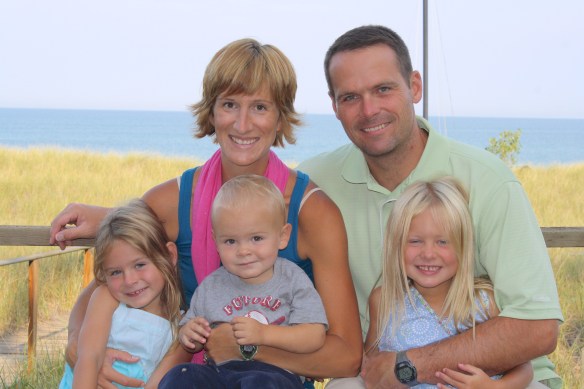
10 years and three kids later.

                      More of our favorite people.

Marriage and the Mass

By Christine Burrows

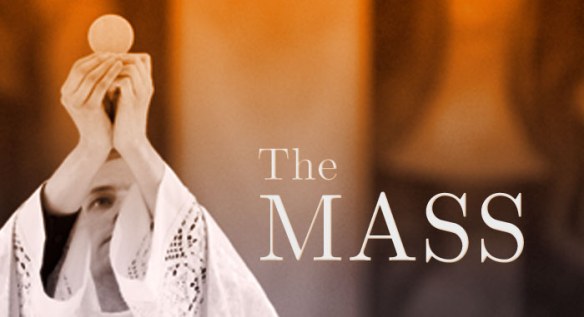
Last Saturday, Peter and I attended Our Lady of Mt. Carmel’s monthly Marriage on Tap event. This month’s speaker was Dr. Tim Heck who spoke, admittedly on a fresh topic for him, about how marriage reflects the liturgy of the Mass. I hadn’t heard anything like this before, so I took some notes. Here’s my summary of Dr. Heck’s message.

Sacred LoveThinking about the elements of the Mass, Dr. Heck took each one and drew a comparison to marriage. For instance, the entrance song at Mass is intended to be a joyful coming together. We sing with enthusiasm and anticipation. In our liturgy of marriage, we should seek to re-enter it with a joyful spirit, welcoming what’s to come. Ideally, we should do this on a daily basis, regularly reaffirming our marriages as a celebration of God’s plan for mankind.

Get it? It kind of works! So, here are the other comparisons he drew:

  • The blessing: As the priest does at the beginning of Mass, spouses should offer one another words and prayers of hope and encouragement.
  • Penitential Rite: As we acknowledge our sins and sinfulness before God, we should pray for the grace to be Jesus to our spouses by being able to forgive at all times.
  • Gloria: Here’s where we give praise and honor and thanksgiving to God. Let’s hear an Hallelujah for our marriages! Shout it out, or at least live it out with true thanksgiving for the sacrament.
  • Liturgy of the Word: Just as we seek to have the Word of God penetrate our minds and orient us toward the eternal, we should seek to use our own words (spoken and written) to inspire our spouses and seek Godliness in one another.
  • Homily: As we hear the Word of God in the readings and Gospel, we turn to the homily to educate and motivate us. Similarly, we should weave God’s language into our dialogue with our spouses.
  • Profession of Faith: When we stand to proclaim our shared faith, we present ourselves as a community of believers. So, too, should our marriage profess our devotion to the sacrament and to each other.
  • Liturgy of the Eucharist: This one requires a whole lesson on Theology of the Body, but, in an abbreviated sense, it’s about physical union. When we receive the Eucharist, we physically bring Christ into ourselves. In the sacrament of marriage, we unite sacramentally and physically.
  • Sign of Peace: We may see this part of Mass as a simple greeting, but it’s also a way of reconciling with one another. In our marriages, we should bring peace to one another; reconcile and forgive often. Say (and mean) “I love you.”
  • Silent Contemplation: As we end Mass, contemplating the greatness of God and the privilege to join with Him in Holy Eucharist, so, too, are we called to reflect on and give thanks for our marriage. Breathe in the grace of the sacrament. 

What do you think? Does it work as a way to consider your own marriage sacramentally? I’m thinking it might be another way to reflect on how our faith and the rituals within it transcend the actions of attending Mass or rote prayer. When we have parallels to think about that tie us back to our “real lives” it often gives us a greater sense of wonder in the routine. I hope next time you’re at Mass, you remember just one of these and think about your marriage, and maybe head back home with a re-commitment your spouse.

God is Love

Do You Need God in Your Marriage?

Posted by one of our favorite guest bloggers, Anne Johnson Slamkowski.  Visit her blog when you have a chance, please.

I was sitting at a meeting the other night and several of the women were talking about how they were doing this “Husband Project” with their husbands (the book is “The Husband Project: 21 Days of Loving Your Man–on Purpose and with a Plan” by Kathi Lipp).  It involved following steps and treating your husband with respect (at least that is what I heard them say).  I liked the idea.  It certainly sounded like it was working for the most part for each of them.  It made me think about my own marriage relationship.  I am not sure I need a book to do good things for my husband, but I am also not so sure that Pete wants me to follow a book.  I think the premise is wise, but it might just miss the point of keeping your marriage alive.  There are varying statistics on the divorce rate in the USA, but it is somewhere between 40-60% depending on the area that you live.  That is HUGE – 40-60%.  WOW!

Busy-Parents

Pete and I have spoken at marriage retreats (in fact we are due for a speaking engagement coming up at our own church).  We have looked at our marriage from different viewpoints to see how we can make it better (which by the way, you always can improve upon your marriage).  We recognize that we speak different Love Languages (“The Five Love Languages” by Gary Chapman).  We also admit readily that children thrown in with marriage complicate your relationship in good and bad ways.  In addition, let’s throw in your family of origin (the preconceived ideas that you bring with you into the marriage) and your communication skills, and let’s just say that marriage doesn’t seem to have much of a chance with all the baggage that we overload it with.  BUT overall Pete and I both would agree that our marriage has been strengthened tremendously in the last six years because God has become the center of it.  We finally realized that God must be part of our relationship in order for it to work.  Without God, our love for each other will be nothing but physical.  Mentally, we need God to make it all fall together.  We need God in our individual lives and our married lives in order for this to work.

No books, no steps, no love languages will ever equal what God does for your marriage. healthy habits happy homes Recognizing that God is part of the marriage will give you the mental and physical passion that is needed within the sacrament of marriage.

Colossians 3:12-19   So, as those who have been chosen of God, holy and beloved, put on a heart of compassion, kindness, humility, gentleness and patience;  bearing with one another, and forgiving each other, whoever has a complaint against anyone; just as the Lord forgave you, so also should you. Beyond all these things put on love, which is the perfect bond of unity.  Let the peace of Christ rule in your hearts, to which indeed you were called in one body; and be thankful.  Let the word of Christ richly dwell within you, with all wisdom teaching and admonishing one another with psalms and hymns and spiritual songs, singing with thankfulness in your hearts to God.  Whatever you do in word or deed, do all in the name of the Lord Jesus, giving thanks through Him to God the Father. Wives, be subject to your husbands, as is fitting in the Lord. Husbands, love your wives and do not be embittered against them.

If we are going to fight to keep our marriages together in this country, we must find a way to put God first in our own lives.  We must find a way to put God in the midst of our marriage.  No marriage can survive (at least with joy and happiness) without God as part of it.  The Colossians verse above says, in order to be holy and beloved we must put on a heart of compassion, kindness, humility, gentleness and patience.  How can we do any of that without God as part of our life?  How on earth can we forgive our loved ones and not hold grudges if God is not part of our life?  It goes on to say, “let the word of Christ RICHLY dwell within you.”  Richly gives me the feeling of soil that is ready to farm.  Once we let Christ dwell within us and get us ready for the seed of Marriage, then we are ready to produce a beautiful family that will survive anything.  If we start with rocky or weedy soil, the marriage becomes a little more complicated.  We have to somehow find a way to fertilize our life with God after the fact.  When we complicate things with pre-marital sex, co-habitation and multiple partners, it is like starting with rocky soil.  I am not saying that if you have made these choices that your marriage won’t last.  What I am saying is it will be more difficult for your marriage unless you fertilize it with God in your life.

Throughout my book, “Revealing Faith: Learning to Place God First in Your Life,” I continually stress that my choices were not good ones in my twenties.  Pete and I started with rocky soil.  Although God was present in my life by the time we married, He wasn’t the main focus of my life.  It would take years for Pete and me to build and fertilize our soil so that it would withstand tough struggles that lay ahead.  We even added children into our marriage before we had fully fertilized our life with God.  It was a struggle.  Once we both refocused our life toward God (which we did after a wonderful marriage retreat at our church in Champaign, Illinois), we realized that we were missing a very important person in our marriage: God.  As our individual faith lives grew (over many years), our soil became more and more fertile.  When we finally gave birth to our third child, Katie, we were faced with a tremendous struggle.  Katie suffered from multiple medical problems at the age of one (she suffers from complex partial seizures).  Later we would find behavioral issues and anxiety laced with depression to be part of Katie’s life.  If Pete and I had not fertilized our life with God, I could see where this would have made our marriage very complicated and difficult (and trust me it still is a struggle), but with God in the center of our marriage it all seems doable.  We rely on His strength.  Our kids rely on His strength.  We thank God to this day that He entered our marriage and let us re-fertilize our family with his Wisdom.

My favorite part of the Colossians verse is that we admonish one another with psalms and hymns and spiritual songs.  Well, Pete and I don’t go around singing to each other (thank goodness), but we do listen to praise and worship songs together, we sing psalms at church together, and we find ways to love each other by sacrificing our selfish desires in order to place God’s Will first.

happy young couple