Pillow Talk

In 2008, when we were first discussing the creation of a ministry at Our Lady of Mt. Carmel dedicated to fostering a community that supports married couples in our parish, I recall commenting to Denise McGonigal that this could not simply be about “the theory of marriage.”  That, in order to be successful, grow, and attract married couples from every demographic in the parish, it needed to focus on real-life issues, and to include concrete examples of how happily married couples make marriage work.  This stance would be leavened with a strong dose of Catholic spirituality, keeping in mind our mission to celebrate the joy of sacramental marriage, as eloquently expressed in Pope John Paul II’s Theology of the Body.

So, here we are on Valentine’s Day, preparing for our monthly Marriage on Tap event tonight at which over 60 couples will be receiving eucharist, renewing their marriage vows, enjoying a date night meal together, and sharing thoughts and ideas around Denise’s presentation about marriages made in Heaven.  An intimate, non-commercial celebration of what marriage CAN be when spouses allow the Holy Spirit to enter their relationship and commit to each other to be the best husbands, wives and parents they can be.

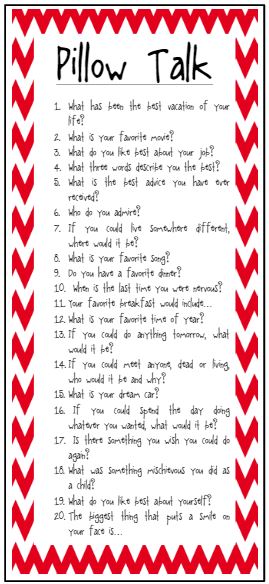
As one of the more secular voices on this blog, I’m always searching mainstream media online for articles and ideas I can steal borrow to share with our readers.  Today I discovered a cheat sheet useful for facilitating conversation in the marital bed.  Why many of us are more comfortable conducting these conversations in our living rooms than in our bedrooms is a mystery.  My own theory, what Nancy would call “the story I’m telling myself,” is that these conversations will either lead to sex or NOT lead to sex, depending on which spouse is more inclined in which direction, comprising one of the worst sentences ever to grace these pages.  She, I suspect, would say it has nothing to do with any of that, that it’s probably due to more practical considerations; in our case, I wear a CPAP mask, which makes it practically impossible to talk, and works, for her, like talking with an astronaut.

Enough.  Here is the Pillow Talk piece borrowed from TheDatingDivas.com:

PIllow Talk


LSE Papyrus logo

Well said, Dr. Rutherford

Dr. Margaret Rutherford bills herself as a “Clinical Psychologist, Mental Health/Midlife Blogger.”  (She also provides a handy response to the challenge of naming one good thing about Arkansas.)  Just kidding.  At any rate, I thought this post was so good, and so well-written, that I would just copy and paste it herein.  I’ve taken the liberty of bolding those items that speak to me loudly.

Wedding

24 years of marriage.

That’s what September 15th meant for me.

We had celebrated earlier so I didn’t remember until I was driving to work. I called him. Told him I loved him. I got grocery store flowers when I got home. Beautifully arranged by the way.

What ever did we do without grocery store flowers?

Between being a marital therapist and my own experience, I have learned a few things. Since I am on year #24, I’ve divided them into 12’s. Just to be cute.

12 Things That Marriage Is Not:

1. Marriage is not for sissies. It’s hard work.

2. Marriage is not about getting what you want all the time. It’s not a dictatorship. It’s not wanting to win all the time because that would mean the other person would lose all the time. May be OK for you. Not good for the marriage.

3. Marriage is not rocket science. The principles it’s based on are really pretty simple. Kindness. Respect. Loyalty. That kind of thing.

4. Marriage is not unfashionable. It stays vital. Even Brangelina must think so.

5. Marriage is not in and of itself stimulating. Since you are with the same person over a long time, the two of you can get in a rut. You have to keep things fresh.

6. Marriage is not about collecting things. The joys of marriage aren’t tangible. You live them. That’s what makes them so very special.

7. Marriage is not for the impatient. Some of the best stuff takes a while to develop. You have to stick around to find that out.

8. Marriage is not the place for criticism. Or abuse. If it is found there, it will ruin any chance of true intimacy or trust and dissolve the hope that once might have existed.

9. Marriage is not a 24-hour repair shop. Your marital partner is not supposed to meet your every need. Some of those needs you may have to take care of yourself. Through your friendships or other activities.

10. Marriage is not self-sustaining. It does not thrive on its own. If all you focus on is the kids, you are making a mistake.

11. Marriage is not boring. Two lives woven together can be quite exciting! There’s just something about watching someone very different from you, living their life in an extremely different way. Up close and personal. You learn from that.

12. Marriage is not without conflict. Knowing how to disagree and work through anger and disappointment is probably the key to lots of stuff going well. Getting to that cooperating, mentioned in #2.

2014-09-26-Marriageisgettingirritatedbythethingsthatalwaysirritateyou.Andtoleratingitbecauseitiswayoverbalancedbythegoodstuff1.jpg

12 Things That Marriage Is:

1. Marriage is the potential for an intense, deep and diverse intimacy. Sexual. Emotional. Relational.

2. Marriage is knowing someone has your back. Always. You have theirs. It’s about interdependence.

3. Marriage is realizing that you have been seen in your worst times, and that you are still loved. There’s an overriding sense of gratitude and security.

4. Marriage is sharing old jokes. Or some story that may be told over and over but it still makes you laugh ’til you are left gasping for breath.

5. Marriage is getting teary-eyed together.

6. Marriage is thinking about the other one not being there anymore. And not being able to think about it.

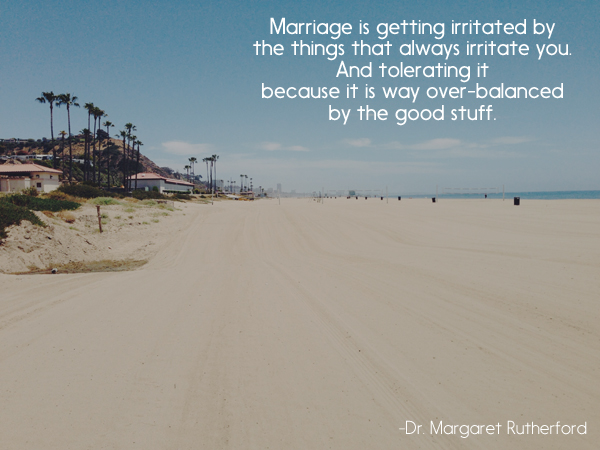
7. Marriage is getting irritated by the things that always irritate you. Have irritated you for 24 years. Will irritate you for 24 more. And tolerating it because it is way overbalanced by the good stuff.

8. Marriage is not being able to wait to get home to share some little something.

9. Marriage is wishing you were the one having the operation. Or the illness. Not him.

10. Marriage is sometimes fighting. Trying to slowly learn to fight more fairly. To apologize. To listen. To learn. To find resolution.

11. Marriage is about vulnerability. Giving someone the right to hurt or disappoint you. While simultaneously giving that someone the opportunity to bring you tremendous joy and laughter.

12. Marriage is a promise. A vow. To try the hardest you have ever tried in your life. Marriage is a place for the achievement of a personal integrity like no other.

I’m now living year #25.

So far. So good. Thanks for reading! You can find more from Dr. Margaret at http://drmargaretrutherford.com!

LSE Papyrus logo

12 Years, 12 Lessons

Another post from the surprisingly insightful editors at Huffington Post.  Huff may not be your cup of team when it comes to politics, but they run some great articles on the subject of marriage.  Even with the secular bent, there are useful tips here.

Parents and kidsHere are some comments on the lessons that resonate with me:

  • 50/50 expectations inevitably lead to keeping score.  We have argued here that a 60/40 balance, where each spouse is willing to give 60% in exchange for 40% (and an equity position in the marriage) reduces score-keeping which, in turn, reduces arguments over who is carrying the load and who is slacking.  If your spouse is slacking big time–usually the husband, in my opinion–you need to address it, but in a friendly, non-confrontational manner.
  • Courtship cannot end when she says, “I do.”  Even in this age of liberated women (most of whom seem to be in their 40’s and older) husbands are well-advised to go the extra mile to keep the home fires burning, as it were.  Planning and executing rejuvenating date nights is harder than it was pre-kids, but you need to do it anyway. And wives, please don’t forget that your husbands still relish the thought of being seduced by you every now and again.  Just sayin’.
  • Digging in when it gets hard.  Marriage is pretty easy when things are going well, but when life throws us a curve or, worse yet, a beanball, couples need to lean into one another with resolve to weather the storm.  This compares to a previous essay describing the attitude of millennials toward marriage, in which it seems preferable to be able to just wash one’s hands and walk away into a new relationship.
  • Being here now–proximity does not equal presence.  If the two of you spend couple on cell phonesyour time at a romantic little restaurant on your phones, you’re missing out.  Establishing boundaries, such as turning off your phone when you get home from work, will enhance the intimacy in your relationship.  The job stuff will always be there tomorrow; the same cannot be said of your spouse.
  • My wife Nancy facilitates Bible study and recently drew a comparison between attendees who consume Bible study versus those who create it.  Applying the same contrast to marriage, if we are to manage a successful long term relationship we must do more than simply consume the benefits.  We must create, through curiosity, conversation, comfort and consideration, an environment in which both spouses enjoy the pleasures of an intimate relationship with one another. Guys, here’s a news flash–being happily married is not simply her job.
  • As Christians, we are called to forgive one another, even our enemies and those who wish us harm.  Forgiving one another, graciously and completely, is an important element of marriage.  If we are to forgive sworn enemies, are we not to forgive our best friend, our closest confidant, our lover and life partner?  Some marriages, in which cheating, lying, addictions and violence are routine, may exist outside the boundaries of forgiveness, in need of dissolution/annulment.  But in the majority of marriages, we should emulate God, be slow to anger and quick to forgive.

WeddingValentine’s Day is coming soon.  What are YOU planning to show your spouse how much you love being married?

Love's Sacred Embrace Masthead

Looking Back at Marriage from the Finish Line

old-couple in loveOur most recent post was an unsettling look at marriage from the perspective of people in their 20’s, the so-called Millennials.  It talked about “beta testing” relationships, about seven-year options with the right of renewal, etc.  Worth reading, if you have the time. Today’s post examines marriage from the perspective of couples who have been married up to 76 years.  The original article, written by Nancy Hellmich, appeared in USA Today.

Based upon research gathered from interviews with 700 retired people, gerontologist Karl Pillemer has written a new book, 30 Lessons for Loving: Advice from the Wisest Americans on Love, Relationships, and Marriage. Pillemer, the founder of the Cornell Institute for Translational Research on Aging, has been married for 36 years to his own high school honey, Clare McMillan.  Treading dangerously close to plagiarism, I want to share the highlights of the advice I gleaned from his research, as follows:

  • Follow your heart when choosing a spouse.  This was beautifully described as “the thunderbolt” in The Godfather, whose Michael Corleone experienced it while courting his future wife, Apollonia Vitelli, but I digress.  The point is, one shouldn’t get married simply because it seems like the right time.  He or she must make one’s heart “soar like a hawk.”  And although young love is no guarantee, perhaps we should describe it as necessary, but not sufficient. Wedding
  • Use your head, too.  If he or she has a gambling issue or drinks too much, is financially irresponsible or flirts incessantly, it raises the odds against a successful long term union.  Our future mate need not be perfect, but there are some definite dealbreakers out there that all of your love and care won’t overcome.
  • Seek shared values.  Sure, opposites attract, and spouses with different temperaments can enjoy very successful long term relationships.  My wife Nancy and I are different in many ways, but we share core beliefs in raising children, handling money, deferring immediate gratification to achieve long-term goals, etc.  In college, I thought of this a seeking a woman with a “coefficient of boredom” similar to mine, one who could enjoy life at a pace midway between frenetic and lethargic.
  • Find someone with whom you can communicate easily.  It is unrealistic to suppose that Chatty Kathy is going to be able to sustain a relationship with Strong Silent Ken. I’m big and loud and still recall how happy I was to have met a woman in Nancy whom I could not intimidate.  Back when I was in the insurance business I had a client with a basic high school education who operated a food truck and was married to a pediatrician.  I don’t know what became of them, but I remember thinking at the time that they didn’t seem to have much in common.  If you and your intended have trouble talking about important stuff now, it probably won’t get any easier as you age.Parents and kids
  • Choose the time and place to discuss difficult subjects.  My mom used to say that timing is everything, which may or may not be true, but tackling difficult subjects must be done with some forethought.  I may not welcome a conversation about disciplining the kids when I’m in the middle of painting a room.  She may not want to discuss my budget concerns while preparing dinner for eight.  You get the idea. There’s a time and a place for everything.  And while you can’t, and shouldn’t, avoid the hard talks, you can certainly approach them with some discernment.  “Listen, after the kids are in bed tonight, can we talk about that argument we had at breakfast?”
  • Put your relationship first.  Ahead of your family, your kids and your friends.  Ahead of your work, your hobbies, even your favorite NFL team.  If your spouse feels you care more about golf than you do about her–even assuming she’s wrong–there’s gonna be trouble in River City.  Just sayin’.  And, like it or not, your kids should have to fit in your lives; you should not have to build your lives around them.  Just because you would give your lives for them doesn’t mean you should, unless push comes to shove, which it rarely does.
  • Develop some ground rules around in-laws.  They can enrich your lives, they can become a burden, or some of each.  The important thing is to find common ground concerning when, where and how much time you spend with them.  My mom told me to check out a girl’s mom, because that was who she would someday become.  I could argue that perhaps Nancy should have taken a closer look at my father, since he’s who I have become.  And though these prescriptions are offered somewhat tongue-in-cheek, there is something to them.
  • Pillemer says that “marriage is made of thousands of micro-interactions” which John Gottman refers to as “bids” in his own research.  It is hard to give one’s wife too many compliments, indicating not that you are a fawning dolt, but rather that you notice and appreciate the small things she does for you.  If your love language is acts of service (as mine is), it’s nice when they are noticed and received graciously.
  • Cute-Romantic-Love-CoupleMaintain your physical relationship as you age.  Not doing so puts you at risk of developing a spiritual distance between yourselves.  As Toby Keith says, “I ain’t as good as I once was, but I’m as good once as I ever was.”  Even if you’re beyond Toby’s stage, it is important to maintain physical intimacy in your marriage.  Pope John Paul II’s “Theology of the Body” proclaims that marital intimacy is a gift from God, and we should treat it as such.
  • Finally, it is important to be friends first.  This doesn’t come from Pillemer, but from me, John Gottman, Art and Larriane Bennett and countless students of the game. Can you imagine an argument with your best friend that would cause the two of you to stop being friends?  Me neither.  So it stands to reason that if your spouse is your best friend, you can weather any number of storms in your relationship, knowing that you’ll make up and find a way to laugh off whatever it was.  If you’re just lovers, you might choose to walk away from each other when things get rough, as they will. Being friends first gives you a powerful motivation to solve problems, soothe feelings, and put things right.

LSE Papyrus logo

Happiness, too, is often an act of will

Busy-ParentsMy friends and I have been doing a terrible job keeping up with this blog this summer.  No excuses.  As fall approaches, we hope to revive this site and bring some new energy to our ministry and our marriages.

Recently, our community was shaken by a murder-suicide that took the daughter of one of our most prominent and generous families.  Events like this, which drastically change the trajectories of numerous lives are, mercifully, pretty rare.  I pray virtually every day that God’s will for me and my family does not include a tragedy like this.  For the grieving family, most of what follows will seem like empty words; their solace will come from God and leaning into one another.  For others, I hope you can find some useful ideas below.

As we have pointed out numerous times on this site, love is an action, not a feeling. Feelings come and go, while the actions of our wills are up to us; we are in control of our wills.  Thus, we have the ability to be in control of our relationships.  Much the same can be said for happiness.  We have the ability to create our own happiness.  Heck, there are even exercises we can do to upgrade our own happiness.

In her book The How of Happiness: A New Approach to Getting the Life You Want, CBurrowsphoto #1author Sonja Lyubomirsky takes a clinical approach to examining the subject of happiness. This study is briefly summarized in one of my favorite blogs, The Generous Husband. As blogger Paul Byerly observes, this is an important subject, as happy, effective, successful people have better marriages.

Theology of the Body: Practicum

happiness image #2 ChristineTo my immense surprise, I find that as I age I continue to see more of my feminine side emerging. That I have a feminine side at all is a bit of a revelation; that I’m willing to admit it another; and that I see more of it each day an actual wonder.  Yet, here I am, unable to deny the following set of facts:

  • I’m no longer the primary breadwinner in my family, and am okay with that.
  • I do virtually all of the grocery shopping, meal planning and cooking, and I’m okay with that, too.
  • I’ve lost most of my lifelong interest in sports.
  • My second favorite TV show is Project Runway (although Justified, a man’s show to be sure, is still #1.)
  • I’ve started to follow, and am greatly interested in, a number of blogs directed at women.

Is all of this simply a result of the massive amounts of estrogen in public water supplies, Theology of the Bodycourtesy of the almost universal use of oral contraceptives by modern women?  I think not. It is, I believe, a side effect of my blooming interest in the subject of marital intimacy, awakened in me by Joe and Denise McGonigal at a Love’s Sacred Embrace marriage retreat five years ago. There, they presented a series of talks on The Theology of the Body, one of the lasting gifts left to us by Pope John Paul II, which I, as a fairly recent convert to the faith, felt was uncharted territory worth exploring.

All of the preceding is but a long way of admitting that I follow a blog called Intimacy in Marriage by Julie Sibert, subtitled, “Encouraging Christian Women toward Healthy Sexuality.”  Her most recent post, “Three Things Sex Tells Us about the Lord” is worth your time, regardless of your gender.  I encourage you to follow the link to Julie’s post, in that the three headers about which she writes, by themselves, don’t shed much light on the subject:Cute-Romantic-Love-Couple

  1. He understands the power of pleasure.
  2. He trusts us.
  3. He knew marriage would be hard.

As Intimacy ranks #4 on most lists of the things married couples fight about (see the related post on All Pro Dad), if you’re married and following this blog (and why would you if you weren’t?) there are some useful insights in Julie’s post.  Regardless of whether you’re a woman or a man.

Intimacy may have a different meaning for women than it does for men, but the undeniable fact is that without it, regardless of how you define it, your marriage is going to be a long row to hoe.  Anything we as spouses can do to enhance intimacy in our most intimate relationship is good.  Seeking to better understand our partners, and God’s intentions for us, is a great place to start.

I’d like to continue with this, but instead am going to put on my flannel pajamas and woolly socks, grab my box of Godivas, and head to bed to watch Connecticut and Kentucky play for the national title.  One shining moment, etc.  🙂  God bless you.

cropped-lse-masthead6.jpg

Commitment, candor, and communication

Three essential elements of any meaningful relationship.  Beautiful little film.  Enjoy.