A challenge

I came across an interview with Christopher West the other day.  He was asked a question that I am sure many parents struggle with – how do you introduce Theology of the Body to your children?  His response was profound.  Among other things, he said, “we can’t give what we don’t have. As parents, before we can pass the TOB on to our children, we have to immerse ourselves in it.”

His answer really struck me.  Gary and I cannot teach our children this beautiful theology until and unless we truly embrace the TOB – together.  As married couples and parents we cannot give to our children what we don’t already possess ourselves.  As Christopher West describes, evangelizing the TOB to our children is so much more than “the talk,” we must witness the TOB to our children.  As if parenting wasn’t hard enough!

Recently, the USCCB had its annual General Assembly.  In Cardinal Dolan’s address to the bishops he said “[w]e cannot engage culture unless we let Him first engage us; we cannot dialogue with others unless we first dialogue with Him; we cannot challenge unless we first let Him challenge us.”  He added that what is wrong with the world and what is wrong with the church “is not politics, the economy, secularism, sectarianism, globalization or global warming … [w]hat’s ‘wrong with the world?’ is just two words: I am.”  Wow.  Very powerful, especially when we remember that Cardinal Dolan was speaking to a room full of Catholic Bishops.

Cardinal Dolan did not speak these words in the context of the TOB, but doesn’t it make perfect sense?  Take a minute to think about the secular meaning of sex and sexuality in our culture.  Let’s be honest here, most of us buy into at least part of it don’t we?  So, as Cardinal Dolan suggests, the true evangelization begins with “me.”  We must first allow Christ’s message of the TOB into our hearts.  If, and only if, we open our hearts to the beauty of Gods true love can we begin to evangelize to our families, our communities and the world.

Is your heart open?  Mine is … I think.

Evangelization is hard work…and it starts in our bedrooms

Posted by Christine Burrows

The election is over, and there’s no friend of religious freedom in the White House. Does that mean, as some might fret, that the Catholic Church (and all its affiliated organizations) are about to be forever subverted?

I choose not to believe this.

I won’t lie. I am disappointed with the outcome of the presidential race.  Maybe you are, too.  But does that mean we fold our arms, sulk, run and hide, or instead figure out how to save the things we treasure so deeply about our faith by becoming true evangelists?

I choose the latter.

We clearly have our work cut out for us.  Many current cultural and political trends run contrary to our beliefs; we are paddling upstream..This work must start, not in city hall, but in our neighborhoods, our homes – and in our bedrooms.

Our bedrooms?  Yes. That’s where we begin to nurture the most important relationship we have – our marriage. Through the marital embrace and open communication, one plus one equals one.  When two become one, we are stronger. In this strengthened state, we can begin to evangelize in our families. Then, if we’re lucky, some of these seeds will take root in our children, friends, siblings and parents. They, in turn, may then grow in confidence to share the message of our faith with their friends and spouses – and so on.

I saw a Facebook post the other day. It was one that had been liked by thousands of people before my kid’s elementary school classmate posted it. It was a picture of a husband and wife turned away from one another in bed. The accompanying story described a husband who asked his wife for a divorce so that he could marry another woman. His wife asked him to agree to carry her out of their bedroom every day for one month before she’d agree to the divorce. No spoilers here… the mere act of reconnecting with her physically drew the husband toward his wife and away from his desire to divorce….just too late.

Not everyone who read that post took from it what I did, but there’s a simple point to remaining physically connected with our spouses. Sharing home or parenting responsibilities with a spouse isn’t enough to preserve the marriage. That’s just co-habitating or co-parenting.

Real marriage involves a physical and emotional connection that doesn’t happen in any other relationships. And, when that intimacy is nurtured and God is blessing it, we can do just about anything… handle the grueling routines of raising kids, deal with unexpected hardships, and even do the hard work of preserving our faith and religious freedom.

So, let’s start our evangelization efforts in our bedrooms, and fortify ourselves for the harder work of evangelizing the rest of the country.

What We Mean by “Sacred Embrace”

Posted by Christine Burrows

Contrary to popular belief, modern Catholics do not think of sex as bad, shameful, or sinful. In its proper context, Catholics love sex, so much that we regard it as sacred. Ours is a counter-cultural faith, and this is Exhibit A.  For those of you unfamiliar with The Theology of the Body, this is a brief primer to whet your appetite.

It may help to begin by stating clearly what Theology of the Body is NOT.  It is not about the casual, recreational, self-focused sexual encounters portrayed in contemporary media.  It is not about the objectification of women that fuels the pornography industry.  It is not about “scoring”, “getting off” or any of the other vulgar measures of our cultural self-degradation.

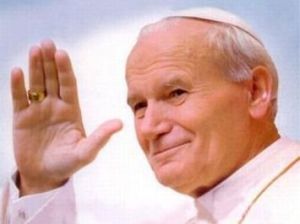
The Theology of the Body is the fundamental Catholic teaching on human sexuality, borne of the writings of Pope John Paul II.  The Pope began this work in 1979 and devoted five years of his pontificate to helping us understand God’s word as it relates to sex within sacramental marriage between a man and a woman.  Few Catholics are aware of it or can claim to any real understanding of it. (Not surprisingly, even fewer people outside the church have even heard of it.)  Which is a shame, because it is a beautiful, intensely intimate portrait of what God intended for us before The Fall.

  • Christopher West is a contemporary expert on Theology of the Body, having spent years unpacking it and presenting it in everyday English to those of us who don’t have the time or talent to fully understand John Paul II’s words.  Check out his videos and books at www.christopherwest.com
  • At the core of Theology of the Body is the truth that God gave men and women complementary bodies, and that “our bodies tell a story, the most beautiful story imaginable.” (Christopher West). Our bodies are uniquely designed and have special characteristics which give us the ability to unite physically and to procreate.
  • A second important premise to Theology of the Body is that we are all searching, longing for something. As Catholics, we believe this longing is to understand and embrace our God-given purpose: to know, love and serve God on Earth and to live happily with him forever in Heaven.
  • When we put together these two basic premises, we see that sex (so intimate, intense, and with the miraculous potential for new life) may actually be a way to quench that longing. The problem with lots of the sex that’s happening today is that it’s distorted, selfish, and incomplete – and has little to do with living out our purpose on Earth. It may satisfy a physical longing, but it doesn’t come close to satisfying our deepest longing to know, love and serve God.
  • Theology of the Body teaches us that sexual intercourse (the marital embrace) is a unifying act between a man, a woman AND God. It is an act of faith, open to God’s will and intervention. Not simply an opportunity to feel good in one another’s physical company, nor the means to getting pregnant. It is a sacred bond that gives us a glimpse of heaven, the uniting of our bodies in accordance with God’s word and his plan for us. It requires trust, submission, the love of one another and the love of God. It is a spiritual encounter of the highest order.

WOW!! That’s heavy stuff, and truly just a teaser. There’s more, much more. Stay tuned here, and dig deeper elsewhere. I dare say that once you “get” Theology of the Body, you will begin to change your entire worldview.  Moral issues will become clearer. Relationships will become more important. And selflessness will become a daily goal. Just imagine if… when… we ALL get it!

Can I have an “AMEN!”

Saving Marriage

The recent election will have countless consequences, some of which we can anticipate and others we cannot.  One thing we know for sure is that as Catholics and Christians our religious liberty is most definitely under siege.  This administration has made it clear with the passage of the Affordable Care Act and its HHS mandate that it does not intend to afford Catholic institutions the religious freedom they deserve under our Constitution – and notably the religious freedom intended by our founding fathers.  Unfortunately, our Supreme Court and most specifically Chief Justice Roberts have given Catholics little hope that the ACA will be overturned in the Supreme Court.  Hopefully, as the specific provisions of the ACA come into practice there will be additional challenges to its constitutionality.  We can only hope that perhaps it will be struck down as unconstitutional on other grounds.

Recently, George Weigel wrote a compelling piece suggesting that Obama’s reelection has “created a crisis for the Catholic Church in the United States.” Weigel specifically addressed the attack on the Catholic institution of Marriage and provided a unique and compelling response to what he believes will be a full-out governmental attack on traditional marriage. He suggests that there should be a “serious debate within American Catholicism on whether the Church ought not pre-emptively withdraw from the civil marriage business, its clergy declining to act as agents of government in witnessing marriages for purposes of state law.”  He adds that “[m]any thoughtful young priests are discussing this dramatic option among themselves; it’s time for the rest of the Church to join the conversation.”

No doubt that in theory Weigel’s proposal makes sense but in practice it might prove to be a difficult move – and one that would certainly garner vicious criticism from our secular media.  However, I agree that the Church would be wise to anticipate the legalization of gay marriage and plan accordingly for its specific response and reaction.  Perhaps, as with the HHS mandate, Catholic Clergy will be forced into civil disobedience.

The New Evangelization means many things, but at its core doesn’t this “movement” call each of us to witness and evangelize the beauty of our faith to the world.  How can we do that if our religious liberties are being stripped from us and we are prevented from practicing our faith the way Jesus instructed us.  Complacency is NOT an option.  The stakes are too high.

Where is the Love?

I remember a guy I knew in college (in the mid ’80s) saying very cavalierly that the last thing he thought about when he was having sex was love. At this time, the sexual revolution was in full swing: The Pill was more common than a multi-vitamin and virginity was becoming a derogatory term. Women were encouraged to be assertive and open with their sexuality. And men were enjoying readily available sexual encounters.

What happened to the love and sex connection?

My thought is that the connection between love and sex was more frequently present before the sexual revolution (and the increased availability of contraception) mostly because there was vulnerability and risk involved in having sex with someone. Birth control minimized this risk, and enabled men and women to hook up without the worry of getting pregnant – or without the openness to it. But, did the vulnerability really disappear? Isn’t being naked in the presence of another a vulnerable experience? Doesn’t working out the awkwardness of sexual intimacy involve being vulnerable? What about communicating about fears, desires, and anxieties? Sadly, these feelings have been dismissed in the name of “free sex”. Often couples enter into sexual relations without ever communicating about these feelings and concerns – and without feeling love – because they CAN. By that, I mean that they can because they don’t have to worry about getting pregnant (even if they do still have to worry about other things such as STDs and simple awkwardness.). What happens then is that all those feelings go untended, and the sex can be more alienating than unifying.

Sacramental marriage reconnects sex and love. It reserves sexual intercourse to marriage, and calls couples to be open, vulnerable, and submissive to one another and to God. This kind of trust in God’s plan involves an intimacy that requires deep, open love. These couples who are open to God’s plan for their marriage don’t fret about risks and vulnerability because they trust God.  While love for another can exist outside of marriage, the fullness of marital love can only be realized when husbands and wives consummate their marriage with openness to life.

As the sexual revolution devolves into commonplace, we need a counter-revolution to restore the relationship between sex and love. I say we start one marriage at a time. Are you with me?

Posted by Christine Burrows