12 Years, 12 Lessons

Another post from the surprisingly insightful editors at Huffington Post.  Huff may not be your cup of team when it comes to politics, but they run some great articles on the subject of marriage.  Even with the secular bent, there are useful tips here.

Parents and kidsHere are some comments on the lessons that resonate with me:

  • 50/50 expectations inevitably lead to keeping score.  We have argued here that a 60/40 balance, where each spouse is willing to give 60% in exchange for 40% (and an equity position in the marriage) reduces score-keeping which, in turn, reduces arguments over who is carrying the load and who is slacking.  If your spouse is slacking big time–usually the husband, in my opinion–you need to address it, but in a friendly, non-confrontational manner.
  • Courtship cannot end when she says, “I do.”  Even in this age of liberated women (most of whom seem to be in their 40’s and older) husbands are well-advised to go the extra mile to keep the home fires burning, as it were.  Planning and executing rejuvenating date nights is harder than it was pre-kids, but you need to do it anyway. And wives, please don’t forget that your husbands still relish the thought of being seduced by you every now and again.  Just sayin’.
  • Digging in when it gets hard.  Marriage is pretty easy when things are going well, but when life throws us a curve or, worse yet, a beanball, couples need to lean into one another with resolve to weather the storm.  This compares to a previous essay describing the attitude of millennials toward marriage, in which it seems preferable to be able to just wash one’s hands and walk away into a new relationship.
  • Being here now–proximity does not equal presence.  If the two of you spend couple on cell phonesyour time at a romantic little restaurant on your phones, you’re missing out.  Establishing boundaries, such as turning off your phone when you get home from work, will enhance the intimacy in your relationship.  The job stuff will always be there tomorrow; the same cannot be said of your spouse.
  • My wife Nancy facilitates Bible study and recently drew a comparison between attendees who consume Bible study versus those who create it.  Applying the same contrast to marriage, if we are to manage a successful long term relationship we must do more than simply consume the benefits.  We must create, through curiosity, conversation, comfort and consideration, an environment in which both spouses enjoy the pleasures of an intimate relationship with one another. Guys, here’s a news flash–being happily married is not simply her job.
  • As Christians, we are called to forgive one another, even our enemies and those who wish us harm.  Forgiving one another, graciously and completely, is an important element of marriage.  If we are to forgive sworn enemies, are we not to forgive our best friend, our closest confidant, our lover and life partner?  Some marriages, in which cheating, lying, addictions and violence are routine, may exist outside the boundaries of forgiveness, in need of dissolution/annulment.  But in the majority of marriages, we should emulate God, be slow to anger and quick to forgive.

WeddingValentine’s Day is coming soon.  What are YOU planning to show your spouse how much you love being married?

Love's Sacred Embrace Masthead

Looking Back at Marriage from the Finish Line

old-couple in loveOur most recent post was an unsettling look at marriage from the perspective of people in their 20’s, the so-called Millennials.  It talked about “beta testing” relationships, about seven-year options with the right of renewal, etc.  Worth reading, if you have the time. Today’s post examines marriage from the perspective of couples who have been married up to 76 years.  The original article, written by Nancy Hellmich, appeared in USA Today.

Based upon research gathered from interviews with 700 retired people, gerontologist Karl Pillemer has written a new book, 30 Lessons for Loving: Advice from the Wisest Americans on Love, Relationships, and Marriage. Pillemer, the founder of the Cornell Institute for Translational Research on Aging, has been married for 36 years to his own high school honey, Clare McMillan.  Treading dangerously close to plagiarism, I want to share the highlights of the advice I gleaned from his research, as follows:

  • Follow your heart when choosing a spouse.  This was beautifully described as “the thunderbolt” in The Godfather, whose Michael Corleone experienced it while courting his future wife, Apollonia Vitelli, but I digress.  The point is, one shouldn’t get married simply because it seems like the right time.  He or she must make one’s heart “soar like a hawk.”  And although young love is no guarantee, perhaps we should describe it as necessary, but not sufficient. Wedding
  • Use your head, too.  If he or she has a gambling issue or drinks too much, is financially irresponsible or flirts incessantly, it raises the odds against a successful long term union.  Our future mate need not be perfect, but there are some definite dealbreakers out there that all of your love and care won’t overcome.
  • Seek shared values.  Sure, opposites attract, and spouses with different temperaments can enjoy very successful long term relationships.  My wife Nancy and I are different in many ways, but we share core beliefs in raising children, handling money, deferring immediate gratification to achieve long-term goals, etc.  In college, I thought of this a seeking a woman with a “coefficient of boredom” similar to mine, one who could enjoy life at a pace midway between frenetic and lethargic.
  • Find someone with whom you can communicate easily.  It is unrealistic to suppose that Chatty Kathy is going to be able to sustain a relationship with Strong Silent Ken. I’m big and loud and still recall how happy I was to have met a woman in Nancy whom I could not intimidate.  Back when I was in the insurance business I had a client with a basic high school education who operated a food truck and was married to a pediatrician.  I don’t know what became of them, but I remember thinking at the time that they didn’t seem to have much in common.  If you and your intended have trouble talking about important stuff now, it probably won’t get any easier as you age.Parents and kids
  • Choose the time and place to discuss difficult subjects.  My mom used to say that timing is everything, which may or may not be true, but tackling difficult subjects must be done with some forethought.  I may not welcome a conversation about disciplining the kids when I’m in the middle of painting a room.  She may not want to discuss my budget concerns while preparing dinner for eight.  You get the idea. There’s a time and a place for everything.  And while you can’t, and shouldn’t, avoid the hard talks, you can certainly approach them with some discernment.  “Listen, after the kids are in bed tonight, can we talk about that argument we had at breakfast?”
  • Put your relationship first.  Ahead of your family, your kids and your friends.  Ahead of your work, your hobbies, even your favorite NFL team.  If your spouse feels you care more about golf than you do about her–even assuming she’s wrong–there’s gonna be trouble in River City.  Just sayin’.  And, like it or not, your kids should have to fit in your lives; you should not have to build your lives around them.  Just because you would give your lives for them doesn’t mean you should, unless push comes to shove, which it rarely does.
  • Develop some ground rules around in-laws.  They can enrich your lives, they can become a burden, or some of each.  The important thing is to find common ground concerning when, where and how much time you spend with them.  My mom told me to check out a girl’s mom, because that was who she would someday become.  I could argue that perhaps Nancy should have taken a closer look at my father, since he’s who I have become.  And though these prescriptions are offered somewhat tongue-in-cheek, there is something to them.
  • Pillemer says that “marriage is made of thousands of micro-interactions” which John Gottman refers to as “bids” in his own research.  It is hard to give one’s wife too many compliments, indicating not that you are a fawning dolt, but rather that you notice and appreciate the small things she does for you.  If your love language is acts of service (as mine is), it’s nice when they are noticed and received graciously.
  • Cute-Romantic-Love-CoupleMaintain your physical relationship as you age.  Not doing so puts you at risk of developing a spiritual distance between yourselves.  As Toby Keith says, “I ain’t as good as I once was, but I’m as good once as I ever was.”  Even if you’re beyond Toby’s stage, it is important to maintain physical intimacy in your marriage.  Pope John Paul II’s “Theology of the Body” proclaims that marital intimacy is a gift from God, and we should treat it as such.
  • Finally, it is important to be friends first.  This doesn’t come from Pillemer, but from me, John Gottman, Art and Larriane Bennett and countless students of the game. Can you imagine an argument with your best friend that would cause the two of you to stop being friends?  Me neither.  So it stands to reason that if your spouse is your best friend, you can weather any number of storms in your relationship, knowing that you’ll make up and find a way to laugh off whatever it was.  If you’re just lovers, you might choose to walk away from each other when things get rough, as they will. Being friends first gives you a powerful motivation to solve problems, soothe feelings, and put things right.

LSE Papyrus logo

The Beta Marriage: How Millennials Approach ‘I Do’

I’m about to do something here I’ve not done before.  I am cutting and pasting an entire article from Time magazine into this space.  The reason is that I’m so completely appalled by the content that I fear readers of this blog might not click on the link and actually read the article.  Here goes.  I’ll have a few observations at the end of the article.

We are a generation reared on technology and choice. Why wouldn’t we want to test a lifelong relationship first? How millennials are redefining “forever.”

You could say I beta-tested my relationship.​

It began with a platform migration ​(a cross-country move) and a bandwidth challenge (cohabitation in a 450-sq.-ft. apartment). There was a false start (botched marriage proposal). Then, an emergency de-glitching (couples therapy). We tried to take the product public before we were ready (I wrote about our relationship in Newsweek). And then, finally, we abandoned launch. There were simply too many bugs.

It’s a joke, kind of — except that when it comes to millennials and marriage, the beta test may be par for the course. And really, why wouldn’t it be? For a generation reared on technology, overwhelmed by choice, feedback and constant FOMO (fear of missing out), isn’t testing a marriage, like we test a username, simply … well, logical?

The findings of a new survey certainly reveal so. In conjunction with a new television dramaSatisfaction, which premiered on USA Network last week, trend researchers asked 1,000 people about their attitudes toward marriage. They found all sorts of things: among them, that people cheat on the Internet (uh huh), that young people don’t think their relationships are like their parents’ (of course), and that everyone seems to have taken to the term uncoupling (yuck).

They also uncovered a surprising gem. Buried in the data was the revelation that almost half of millennials (43%, and higher among the youngest subset) said they would support a marriage model that involved a two-year trial — at which point the union could be either formalized or dissolved, no divorce or paperwork required. Thirty-three percent said they’d be open to trying what researchers dubbed the “real estate” approach — marriage licenses granted on a five-, seven-, 10- or 30-year ARM, after which the terms must be renegotiated. And 21% said they’d give the “presidential” method a try, whereby marriage vows last for four years but after eight you can elect to choose a new partner.
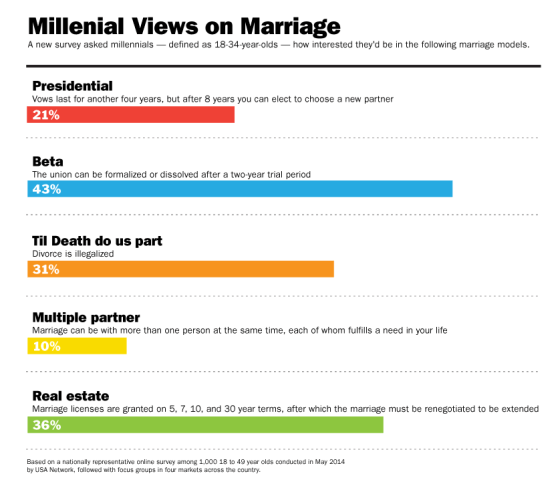
marriageIn total, nearly half of all of those surveyed, ages 18 to 49 — and 53% of millennials — thought marriage vows should be renewed, and nearly 40% said they believed the “till death do us part” vow should be abolished. In other words: Beta marriages! Unions you can test and deglitch, work out kinks or simply abandon course without consequence. “This is a generation that is used to this idea that everything is in beta, that life is a work in progress, so the idea of a beta marriage makes sense,” the study’s author, Melissa Lavigne-Delville, tells me. “It’s not that they’re entirely noncommittal, it’s just that they’re nimble and open to change.”

It’s not a new concept, entirely. In the 1970s, the anthropologist Margaret Mead predicted the growing popularity of “serial monogamy,” involving a string of monogamous marriages. Helen Fisher, the biological anthropologist, has advocated for much of the same: she believes humans aren’t meant to be together forever, but in short-term, monogamous relationships of three or four years. Stephanie Coontz, the author of Marriage: A History, has advised a marriage contract “re-up” every five years — or before every major transition in life — “with a new set of vows that reflect what the couple has learned.”

More recently, Mexico City lawmakers proposed (unsuccessfully) a “renewable” marriage concept, whereby couples could simply renew or dissolve their unions after a period of two years. It’s not so unlike the setup described by a young writer in a Modern Love column in the New York Times last month, about how she overcomes “marriage anxiety” by renewing her vows with her husband every year like clockwork. “I think people are indeed trying to avoid failure,” says Andrew Cherlin, the author of The Marriage-Go-Round.

And, why wouldn’t they? The U.S. has the highest divorce rate in the Western world. The data show clearly that the longer we wait to get married the more successful our marriages will be. And it’s not like we can’t move in together in the meantime: the rate of unmarried cohabitation has risen 1,000% over the past four decades. Not all of our marriages will work, no — but when they do, they’ll work better than at any other time in history, say scholars. And when they don’t, why not simply avoid the hassle of a drawn-out divorce?

“Millennials aren’t scared of commitment — we’re just trying to do commitment more wisely,” says Cristen Conger, a 29-year-old unmarried but cohabitating podcast host in Atlanta. “We rigorously craft our social media and online dating profiles to maximize our chances of getting a first date, and ‘beta testing’ is just an extension of us trying to strategize for future romantic success.”

In an era where, according to the survey, 56% of women and men think a marriage can be successful even if it doesn’t last forever, that might just make sense. Scholars have observed for some time that attitudes toward divorce have become more favorable over the past decade. Millennials in particular are more likely to view divorce as a good solution to matrimonial strife, according to the sociologist Philip Cohen — and more likely to believe it should be easier to obtain.

And, of course, it’s easy to understand why. We’re cynical. We are a generation raised on a wedding industry that could fund a small nation, but marriages that end before the ink has dried. (As one 29-year-old survey respondent put it: “We don’t trust that institution.”) We are also less religious than any other generation, meaning we don’t enter (or stay) committed simply for God. We feel less bound to tradition as a whole (no bouquet tosses here).

And while we have among the highest standards when it comes to a partner — we want somebody who can be a best friend, a business partner, a soul mate — we are a generation that is overwhelmed by options, in everything from college and first jobs to who we should choose for a partner. “This is a generation who has not had to make as many long-term commitments as previous generations, so the idea of not having an out feels a little stringent,” says Lavigne-Delville. “Divorce has happened for a long time. Maybe we should rethink the rules.”

Indeed, at the end of the day, whatever you want to say about the hookup generation, or millennials’ inability to commit, the vast majority (69%, according to Pew) of millennials still want to get married. We simply need a little extra time to work out the kinks.

“Getting married is so much more weighted today, I get the impulse to want to test it,” says Hannah Seligson, the 31-year-old married author of A Little Bit Married, about 20-somethings and long-term unmarried relationships. At the same time, she adds, “I wonder if this is a false control study in a way. Yes, marriage terrifying, it’s probably the biggest leap of faith you’ll ever make. But you’ll never be able to peer into a crystal ball — or map it out on a spreadsheet.”

Jessica Bennett is a contributing columnist at TIME.com covering the intersection of gender, sexuality, business and pop culture. A former Newsweek senior writer and executive editor of Tumblr, she is also a contributing editor for Sheryl Sandberg’s women’s foundation, Lean In. 

So, what are the likely consequences of these attitudes toward marriage?  How likely will couples be to have children in these models?  How likely is it that when these folks finally grow old (not necessarily up) and inconvenient that they will have someone there to care for them?  Where is the discernment, the rapture of discovering your life partner, when there is always some greener grass on a distant hill?  The concept of commitment has been displaced, and instead we see people kicking tires and going for 18 month test drives, constantly on the lookout for the Next Great Hookup. 

Perhaps the most disturbing aspect of all of this is that this generation, as described herein, is accustomed to having the new product or the new release be a radical improvement over the previous one, creating a mentality of “commitment aversion” tied to the FOMO.  Who wants to get stuck with Jennifer 3.0 when Caroline 4.0 might be waiting at the next Starbucks?

We boomers have, admittedly, a pretty terrible track record of making lifelong commitments that provide happiness, stability, well-adjusted children and tenderness that lasts “until death do us part.”  We are aware of how human life has become disposable, though we generally don’t discuss abortion or euthanasia in those terms.  We seem to be seeing marriage being added to the growing list of institutions that have outlived their utility.

Our next post will excerpt some comforting ideas from couples who have been married forever and share their secrets of making love last.

 

We Have Met the Enemy, and He is Us

Happy New Year, couples.  Yes, we’ve been in hiatus for months, dealing with a number of issues ranging from travel and health concerns to a relative lack of inspiration from many of our usual contributors.  Now that 2015 is upon us, I am hoping for some renewed energy and relying on The Holy Spirit to provide it to all of us, with a tip of the hat to Walt Kelly

UnhappyA recurring theme in this blog is that successful marriages are not about finding the right person as much as being the right person.  When things go wrong in our lives, it is not unusual to blame others–employers, spouses, friends, bad ju-ju, etc.  Yet, in most cases, we have only ourselves to blame, which is inconvenient in that it forces us to change our behaviors and/or our attitudes toward the things that comprise our lives.

I direct your attention to a recent article published in Huffington Post (yes, them again) about a failed marriage, written by the now ex-wife.  In a nutshell, her ex lied to her, cheated on her, and finally abandoned the family.  Some time later, in therapy, she realized that her own foibles were at the root of much of what went wrong in the relationship.  I encourage you to read the article, but let me summarize what she refers to as the “four huge mistakes I made” that led to the breakdown of the marriage:

  1. I put my children first.  While it is a holy obligation to care for one’s kids, it is easy to allow them to become a place to escape to when difficulties arise in your relationship with your spouse.  This particular issue typically afflicts wives more than husbands, but men are not exempt, either.  This evokes the instructions we get while waiting for a plane to take off, that we are supposed to affix our own oxygen masks before taking care of the kids.
  2. I didn’t set (or enforce) boundaries with my parents.  While many of us are blessed with parents who live nearby and love interacting with and helping out with our kids, for some spouses this can become burdensome.  Our spouses married us; they didn’t marry our entire families.  For some spouses, when this occurs, it is a hard conversation to have, telling your spouse that you want/need some space from your inlaws.  That conversation, however, pales in difficulty to the one in which you tell him or her you’re moving out.
  3. I emasculated him.  The author’s reflections on this subject are straight out of John Gottman’s Four Horsemen of the Apocalypse–criticism, contempt, defensiveness and stonewalling.  Talking smack about our spouses with our friends simply adds fuel to the fire, stoking our own rage and setting the stage for gossip which can work its way back to the spouse.  “I hear your wife said you’re lousy in the sack” is not something I want to hear while waiting on the first tee with my golfing buddies.  Reading Gottman’s book allows us to both recognize these deadly sins and offers concrete advice on how to work through them.
  4. I didn’t bother to learn to fight the right way.  The notion of “fighting fairly” is one that intrigues me and is, again, a subject to which John Gottman devotes a lot of attention.  All couples are going to disagree at times, and a number of these disagreements can escalate into fights.  Learning how to fight fairly–my wife Nancy is better at this than I am–provides opportunities to turn these arguments into understanding.  Keep in mind that, when it comes to arguing, your objective should not be to win; your objective should be to recognize the root causes of the fight and change behaviors in order to avoid them in the future.  We need to seek understanding rather than victory.  In the long run, winning is less desirable than creating win-win situations.

The title of this post is one of Pogo’s lasting contributions to western society.  When holding_handsdifficulties arise in our marriages, we are encouraged to reflect on how we have contributed to the problem, rather than taking the easy, shortsighted way out and simply blaming everything on our spouses.  It takes two to tango; the reason cliches are cliches is because they are generally true.  Let us pray the Serenity Prayer and look inside ourselves before berating our spouses for their shortcomings.  More often than not, the enemy is us.

Pleasing God, if Only for a Moment

TOn Saturday, February 8, roughly 60 couples renewed their wedding vows at Our Lady of Mt. Carmel.  The event, organized by the Love’s Sacred Embrace ministry, was lightly publicized, yet the response was robust, and included a number of couples that had not previously attended Marriage on Tap or any of the annual retreats.  Those renewing their vows spanned a wide range, from friends married for five months to others married more than five decades.  Father Doerr and Father Arbuckle sounded a bit hoarse when the blessings were finally concluded.  God’s grace was present in great abundance last night.

After dinner, Denise McGonigal and I were chatting about the evening.  She and Joe are young-weddingfacilitating a day-long marriage prep day today at church, prompting us to marvel at the general lack of awareness with which most young couples approach the sacrament of marriage.  Although the demographics of couples getting married for the first time are changing (trending to older and more affluent, while the overall numbers shrink), it’s still true that the vast majority of couples entering into the sacrament have absolutely no idea what they are in for, no idea of the scope and depth of the promises they are making. Generally, they are far more aware of the atmospherics–planning, invitations, seating charts, cakes, rehearsals–than they are of the promises they are exchanging, ostensibly until one of them dies.  Even if they are exceptionally aware and alert, there is no practical way to describe how the entry of children into the equation changes things.  Add to all of this the weight of a popular culture that is generally scornful and corrosive toward the institution of marriage, and it’s no wonder so many marriages fail within the first ten years. In fact, it may be a wonder that so many survive.

The only possible explanation behind the marriages that actually make it until the death of a spouse is God’s grace.  Yet, as Catholics, we are taught that grace cannot be earned, that our only hope of receiving something approaching “our share” is to be open to His Spirit.  Active practice of our faith–attending Mass, prayer, studying scripture, serving the poor and those less fortunate than ourselves–may put us in a favorable position with God, but guarantee nothing insofar as gaining grace is concerned.  Is it, then, simply the luck of the draw?

Perhaps.  But there are things we can do to improve our chances.  As Anne and Pete Slamkowski shared with us last night, we can love our spouses intentionally.  We can read and learn from folks like John Gottman and Art and Laraine Bennettwho have written about the secrets of highly successful marriages.  We can commit to BEING the right person, rather than SEARCHING for the right person, when it comes to marriage.  We can focus on fixing our own flaws, rather than harping on the flaws of our mate.  We can approach the challenges of keeping a home and raising children in a spirit of equality, of shared duties, rather than the common practice (engaged in by many men) of relegating these functions to the wife, an anachronistic vestige of the “women’s work” mentality of the 19th century.  Finally, we can enlist God’s help, through prayers of adoration, contrition, thanksgiving and supplication, to see us through the difficult times, and help us appreciate the good.

WeddingLast night, 60 couples said, in effect, “I chose well when I married you the first time, and I am blessed and happy to be able to marry you again.”  In an age of rampant materialism, obscene popular culture, shameful income inequality, global strife and a planet seemingly dedicated to contravening God’s word, in a small, quiet snowy community in central Indiana, a few of us gave God reason to celebrate His creation.  It was an honor to be a part of it.

LSE Papyrus logo

Hurt people hurt people.

AA logo

Alcoholics Anonymous

Thanks to Fr. Emmerich Vogt and his 12 step ministries for the inspiration behind this post.

As humans, we are wounded by living in a broken, fallen world, surrounded by a culture that seems to celebrate failure, death, violence and decadence.  Similarly, as humans, we seek out other humans as our life partners, and they, too, are wounded by the same fallen world.   Despite our best efforts, we often hurt one another.  Fr. Vogt speaks about spiritual healing, sharing lessons learned through years of service to a variety of 12 step programs and hundreds of participants.  He has developed an entire ministry around the divine inspiration built into these 12 steps.  Listening to him this past weekend, it occurred to me that the 12 steps can be easily applied to our marriages.  With apologies to the founders of Alcoholics Anonymous, I will paraphrase the steps themselves, in order to highlight their relevance to our marriages.

1.  I am powerless in the battle against sin; the spirit is willing, but the flesh is weak. This does not refer to the petty squabbles that all of us experience with our spouses, but to the body blows, the haymakers, the capital sins of infidelity, masturbation, porn addiction, gambling and drug and alcohol addictions that have the potential to ruin relationships.  Not all of us suffer these afflictions, but those of us that do are largely helpless to fight them by ourselves.

2.  Belief that a greater power can restore us.  This is the first step addicts must take in order to begin the healing process, and is thus one of the most difficult.  It is a necessary, but not sufficient, belief.  If we are suffering in our marriages, we are called to find the strength to first believe that we can be saved, that our relationship is not doomed. In one of Jewel’s early songs, she spoke about all of us having “addictions to feed.”  As spouses, we are all addicted to something; we must embrace this belief in order to begin the healing process.

3.  Deciding to turn one’s life over to the will of God.  Probably very few of you reading this have not, in some way, already done this.  It is God’s will that we live together in harmony; if it weren’t, we wouldn’t stand a chance.  Surrendering to the will of God follows accepting the belief that He can restore us.

4.  Taking a fearless moral inventory.  If we are going to succeed as a couple, each of us must take responsibility for our own shortcomings.  Playing the blame game is a guaranteed path to failure.  We must focus on what we refer to as “I” problems, not “you” problems.  In the immortal words of Pogo, “we have met the enemy, and he is us.”  As couples, I believe that, having taken this painful inventory, we must consider sharing it with our spouses.  Or at least as much of it as we can, without hurting our partner.  As Father observes, “Honesty without gentleness is brutality.”  See #5.

5.  Confessing our sins/faults/shortcomings to ourselves, to God, and to one other person–our spouse.  Confession is itself a sacrament, and acknowledging our sins one of the basic elements of the Mass.  By speaking these words out loud, we take away one of the hiding places most of us use to avoid dealing with our sins–not talking about them.  If we are to seek true health, we cannot ignore our illnesses, any of them.  We must bring them out into the light of day, before God and our spouses.  This one strikes me as another of the more difficult steps in the process.

6.  We resolve that we are ready to have God remove the madness from our wounded selves.  We must acknowledge that we cannot fix our addictions alone, and we cannot expect our spouses to fix us, either.  We need to pray to God, in his mercy, to send The Holy Spirit to give us the strength to choose the narrow gate, to take the first steps toward becoming whole, and healed, capable of loving ourselves and worthy of the love of our spouses.  In short, we must first pray, in order to prepare ourselves to be healed.

7.  Humbly ask God to remove my defects.  One of the characteristics I’ve noticed in the people I’ve come to know and love at OLMC is a deep-seated humility, the constant refusal to take credit for all of the good they do, and their habit of always giving credit to God.  My own personal motto, which I do not practice nearly enough, is “Be humble or get humbled.”  We must be willing to knock on the door, God’s door, but we must do it in a spirit of humility, seeking his mercy rather than justice.  This is true with our spouses as well, for as spouses we all need to give and seek forgiveness.

8.  List everyone we’ve harmed, and be willing to make amends with them all.  At the top of the list, right behind God, should be our spouses, for they live in our presence daily, and are most likely to have been hurt by our sinfulness.  There is undoubtedly a long list of people behind them.  It is an inescapable truth that our sinfulness hurts God, and that our spouses bear the brunt of our addictions and faults in the world.  For you, there may be a lengthy list of folks behind the first two, but it is important to start at the top.  For me, the next five names on the list are my children and my parents, for all of them have undoubtedly suffered at my hands, in my thoughts and in my words.

9.  Apologize to everyone you’ve harmed, except when to do so will injure them.  For the living people on your list, including your spouse, this is rather straightforward, but must be approached in an almost spiritual sincerity.  As for God and the deceased persons on your list, it is only through prayer that you will be able to communicate your regret and apology.  Doing so, whether speaking to the living or praying to those others, is a cleansing act, one which should not be dreaded, but rather embraced.  How can we not feel better after having sincerely apologized to those people we’ve hurt?  As a young man, I went to my parents house one day and apologized for every single word that had come out of my mouth for the previous four years.  The three of us shared a toast–several in fact–in celebration of how good we all felt afterwards.  That was over 40 years ago, and I remember it as if it was yesterday.

10.  Commit to a daily examination of conscience.  If we are committed to living in the moment–give us this day our daily bread–we should regularly ask ourselves, “How did I do today?”  Some days will be better than others.  The point is that healing is a process, not a silver bullet, and we must commit to examining our conscience every day.  As addicts, we are capable of falling off our own particular wagon on any given day, and it is alleged to take 21 days to form new habits.  If we are to be healed, there can be no place to run to, no place to hide.  Examine your actions, words and thoughts every day.  If possible, share this process with your spouse; you can help keep each other on track.  After all, in marriage we are not called to achieve Heaven for ourselves, but to help our spouses find their way to Heaven.

11.  Pray and meditate to increase contact with God.  This, again, is a daily activity, as befits human nature.  Most of us don’t suddenly fall off a wagon we’ve been on for months or years; typically, we gradually backslide into our old ways.  This, I believe, is true for people such as myself with food issues.  I need to weigh myself every day in order to avoid waking up one day six months from now and being at the weight I was when I started taking better care of myself.  For others–especially those with alcohol and drug addictions–the world can tilt off its axis almost without warning.  In either case, by increasing our contact with God we are in a better position to enlist his help.  For those of us who find prayer difficult, saying the words of The Serenity Prayer is a fine place to start.

12.  Practice these principals in everything we do.  One of my best friends, who used to have issues around alcohol, once told me that the difference between drunks and alcoholics is that alcoholics go to meetings.  Practicing these techniques in our marriages does not require us to commit to any kind of formal 12 step program.  But it does require us to thoughtfully approach each other in humility, with forgiveness in our hearts, in as honest a manner as possible.   We must be convinced that we ourselves are, in most cases, the problem, and we must share this spirit.  With God’s grace, we will find happiness and peace in our marriages, create loving homes for our children, and model the behaviors that will, in turn, make them good parents to their own kids someday.

LSE Papyrus logo

There’s No Pill for Boring

If you were to organize a game of Family Feud with married couples under the age of 30–Family_feuddividing the teams into husbands versus wives–and the question was, “Which aspect of your relationship do you most fear losing in the next 30 years?”, topping the list for the men would probably be some version of “losing my world-class sexual virility.” Even those of us who consider ourselves to be merely average lovers might put this response in the top three, alongside “no longer being able to support my family” and perhaps “having to become the primary caregiver for our kids/her mom/anyone, really.”  Of course, I have no clear idea as to the answers that might top the ladies’ list, which would require more insight into the female psyche than I’ve ever possessed.

Anyway, the fear of no longer being able to satisfy our wives sexually is, I think, fairly universal among husbands.  Evidence for this comes in the sheer volume of ads featured on ESPN-type sports channels and NFL games for drugs that treated the dreaded “E.D.” and which, by most accounts, adequately address the problem for many, if not most guys. (These ads do not, of course, suggest that, at age 60, our wives may not want us to be Hugh Jackman in the marital bed, instead preferring more of a Michael Buble-type of experience.)  The point here is that, for us husbands and our primary concern growing older–THERE’S A PILL FOR THAT!

Busy-ParentsFor young married couples with children, what few private conversations we’re able to share probably center around the kids, our jobs and the news of the day delivered by our TV sets–sports, a murder somewhere, bad weather, etc.  In the evening, once the kids are safely in their beds, we sit down in front of the TV, suck up a little screen, and then head up to bed, preparing to do battle with the world again the next day.  Published data suggests that married couples with children spend, on average, something like seven minutes a day actually talking with one another.  I suspect that many of these conversational snippets include one or both spouses punching away on a smartphone.

My wife Nancy shared an observation with me years ago that stuck in my head.  She said that the only difference between a person today and that person a year from now is the places he (or she) has been, the people he’s met, and the books he’s read.  For many parents with busy kids, travel opportunities are often limited, our circles of friends include mostly other parents, and we rarely have time to luxuriate with a good book for a few hours.  Over time, these problems change, but don’t go away.  Our children and their schedules continue to dominate our non-work time, even after they leave for college or elsewhere, our circles of friends tend to shrink as people move or get divorced, and the amount of free time available to us never seems to grow.  If we’re fortunate enough to advance in our careers, work increasingly intrudes on both our family and free time.

As the expression goes, life is what happens while we’re busy making other plans.   Suddenly we’re in our fifties, empty-nesters, with fewer friends than we used to have.  Our careers may be winding down, or perhaps we’ve been displaced from once lofty jobs and have joined the legions of post-50 workers facing unemployment, or under-employment, in which the job satisfaction quotient is drastically reduced, along with the space in our consciousness formerly occupied by work.

As couples, the question, suddenly, is, “What are we going to talk about together?”  If you couple talkingtrack divorce statistics, you see the predictable spike around the so-called “seven year itch”, but then observe another one that jumps up around year 30.  It is this second one that we must prepare for, as it is avoidable and at least as destructive as the early one.  It is the one that would leave us facing the rest of our lives alone, damaged by the loss of three decades of our personal life story, contemplating the brutal prospect of re-entering the “dating game” and its attendant impossibilities.  As Catholics, it is also one bereft of the possibility of a second marriage, one which is even more likely to fail than was the first.

The challenge, and the opportunity, is to remain interesting to each other.  To take advantage of the occasional stolen minutes or hours while we’re young to go to a museum or gallery, meet some new people through, say, volunteer work or a parish ministry, and to read books.  Reading books is, by far, the easiest, as Kindles and books-on-CD offer opportunities to turn dead time spent waiting in airports, driving our cars, or waiting in our cars for soccer practice to end into time spent staying relevant and interesting.  What we see, where we go, and what we read is not nearly as important as the seeing, the going and the reading itself.

The momentary discussions about our kids, our jobs and the news du jour will, over time, give way to expanses of time together.  When that time comes, it is important that we have things to talk about.  As we mature, we owe it to our spouses, even if we can’t stay physically buff and movie star-gorgeous, to remain interesting, aware of the things each other takes pleasure in, and capable of conducting a coherent personal conversation. Otherwise, we are at risk for becoming incurably, terminally dull.  And there’s no pill for boring.

old-couple in love